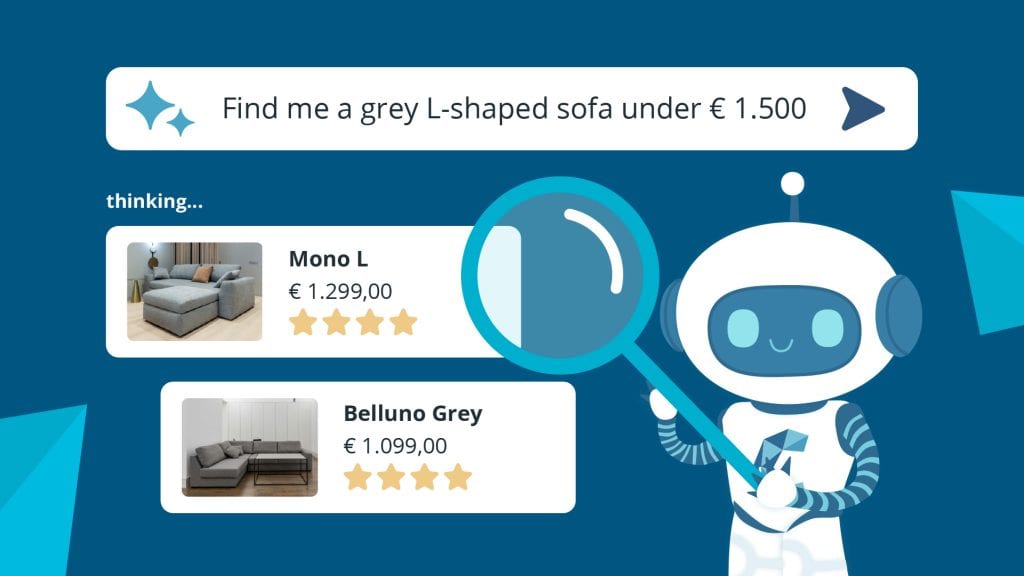
Imagine giving an agentic AI the instruction: “Find me a grey L‑shaped sofa, under €1,500, with good reviews and delivery within one week.” No further clicks, no price comparisons, no lengthy research across countless open tabs. The agent handles it – completely, autonomously and reliably.
What may still sound like science fiction is already a reality in early use cases. And it is fundamentally changing the way e‑commerce works – and how leads are generated.
While agentic search is already redefining such scenarios in the US market, Europe’s delayed adoption offers domestic companies a valuable but limited window of opportunity. Those who act now can secure decisive first‑mover advantages before technological pressure becomes unavoidable.
Table of Contents
Agentic Search vs Traditional Search
When you search for a product on Google today, you receive a list of results. For some queries, you may already see answers generated via AI overviews, or switch to the “AI mode” tab. Both – together with large language models (LLMs) such as ChatGPT or Gemini – are clear signs that search is evolving.
However, the fundamental principle has not yet changed – not fully.
You click, compare and decide. You make the decisions; the search engine merely provides options – albeit increasingly well‑structured ones.
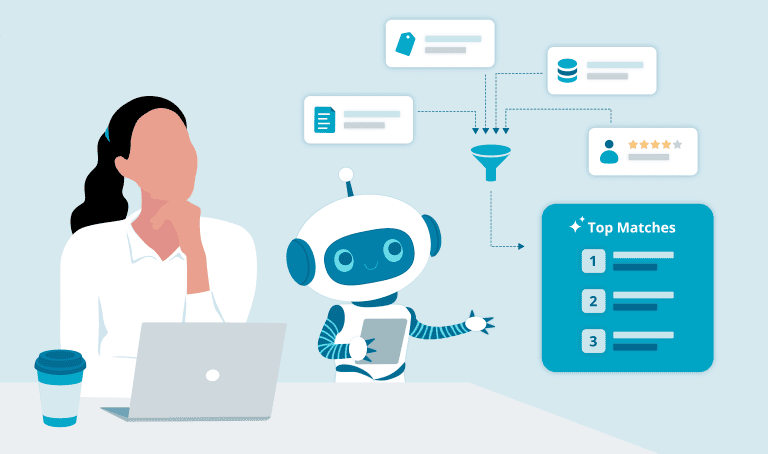
Agentic search works differently. Here, an AI agent does not just perform the search, but also evaluates results, compares options and – in some cases – even makes the final decision or completes the purchase. The human defines the objective; the agent takes action.
At first glance, this may seem like a simple extension of existing search models. It is not. It represents a fundamental paradigm shift – away from humans as active decision‑makers and towards humans as task‑setters.
Importantly, companies no longer have to develop this technology themselves. While complex in‑house solutions still require major IT projects, specialised SaaS agents (Software as a Service) for tasks such as price negotiation or sourcing are already available in the US. As a result, the focus shifts from programming to strategically configuring digital experts.
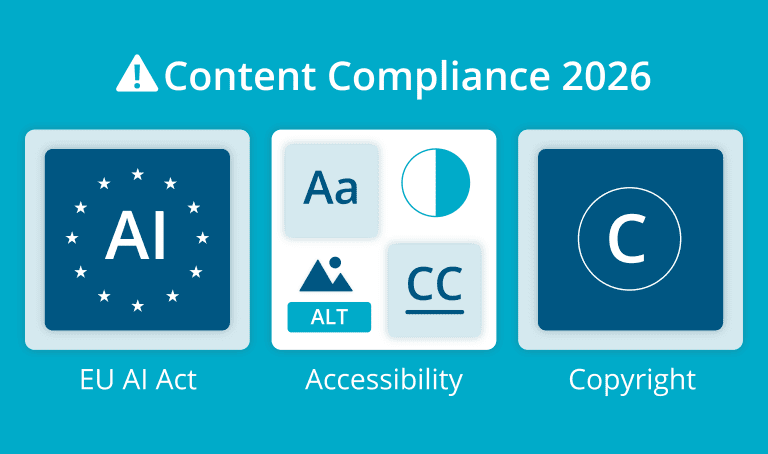
In Europe, however, adoption is likely to lag behind. GDPR and the EU AI Act require robust frameworks for data protection and liability before agents can operate fully autonomously at scale. The technology is ready – regulation ultimately determines the pace.
What Is Agentic AI?
Agentic AI refers to AI systems that can independently plan and execute tasks while accessing external services, websites or APIs. They do not simply react (like a chatbot), but act proactively: setting goals, making intermediate decisions and refining their approach step by step until the objective is achieved.
Well‑known examples include OpenAI’s Operator (US), Anthropic’s Claude with tool use, and Google’s Project Astra. These agents can independently visit websites, complete forms, compare products – or qualify leads.
Agentic Commerce – The Bot as the New Customer in E‑Commerce
The question of who actually buys from you will no longer have a straightforward answer. In agentic commerce, this is already changing fundamentally: increasingly, it is not a human interacting directly with your shop – but their agent.
This applies equally to quick consumer purchases and complex B2B procurement processes, where AI systems review, compare and pre‑select offers long before a human becomes involved.
This has far‑reaching consequences, particularly in two areas:
- Lead generation: AI agents pre‑qualify providers before any real sales conversation takes place. If you do not appear in this pre‑selection, you are not even considered – regardless of how good your product may be.
- Personalisation: An agent knows its user’s preferences, budget and priorities precisely. It filters offers based on data, not intuition – ruthlessly so. If your criteria are not met, or not clearly communicated, you are eliminated.
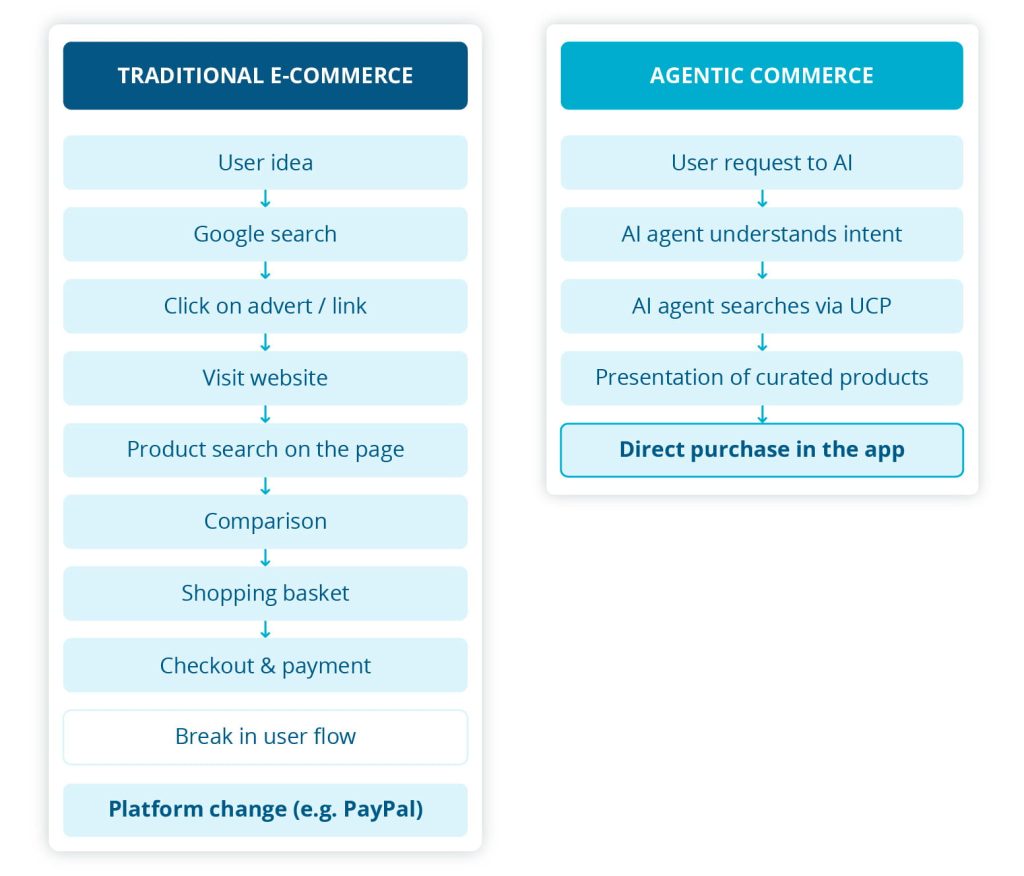

For businesses, this means the first impression is no longer made by a human – but evaluated by a machine. Whether a product image is visually appealing becomes secondary. What really matters is whether your content is structured, complete and machine‑readable, allowing an agent to process it and consistently represent the brand across all digital touchpoints.
Agentic Commerce – Already Reality in the US
That purchasing via autonomous agents is no longer a future vision is evident from developments in the United States. Leading companies have already transitioned from purely human interaction to systems that independently make decisions and finalise transactions.
Walmart (B2B – Autonomous Negotiation)
Walmart uses AI agents from Pactum to scale procurement across more than 100,000 long‑tail suppliers. Renegotiating thousands of small contracts annually is highly resource‑intensive – so the AI handles it. It conducts text‑based negotiations on prices and payment terms in real time. The result: successful agreements in over 70% of cases, delivering significant efficiency gains and optimised cash flows.
Klarna (B2C – Autonomous Checkout)
In the consumer market, Klarna acts as a personal shopping concierge. Using the “Agentic Commerce Protocol”, the AI acts on behalf of the user. Instead of browsing shops themselves, customers define an intention (e.g. “Buy me a sustainable sports outfit under €200”). The agent compares offers, checks availability and completes the purchase autonomously using secure payment tokens (e.g. via Stripe). Traditional webshop visits are replaced by delegated transactions.
Lead Generation in the Age of Agentic Search
Significant changes are also taking place in B2B. For many years, lead generation was built around attracting potential customers to a company’s website through traditional Google Search, LinkedIn Ads or content marketing. However, with Google’s new Intelligent Search and autonomous AI agents, this journey is changing dramatically.
In a world shaped by agentic search, this process works differently. An AI agent searching on behalf of a company for suitable software solutions will not simply land on your website and navigate your menu. It will specifically search for structured information – pricing models, integrations, use cases and customer reviews.
If your content is not optimised for agents, you are simply excluded from the selection process – before a human is even involved. AI agents thus become the ultimate gatekeepers of lead generation.
Trust and Data Quality: The Critical Success Factors
Trust is doubly important in agentic commerce. On the one hand, consumers must trust that an AI agent acts in their best interest. On the other, businesses must ensure that their data is accurate and reliable – because agents make decisions based on that data.
This is not merely theoretical. Incorrect or misleading product information can lead to flawed purchasing decisions, with legal and reputational consequences. Clear approval workflows and a central, versioned source of truth for all product content are no longer optional – they are essential.
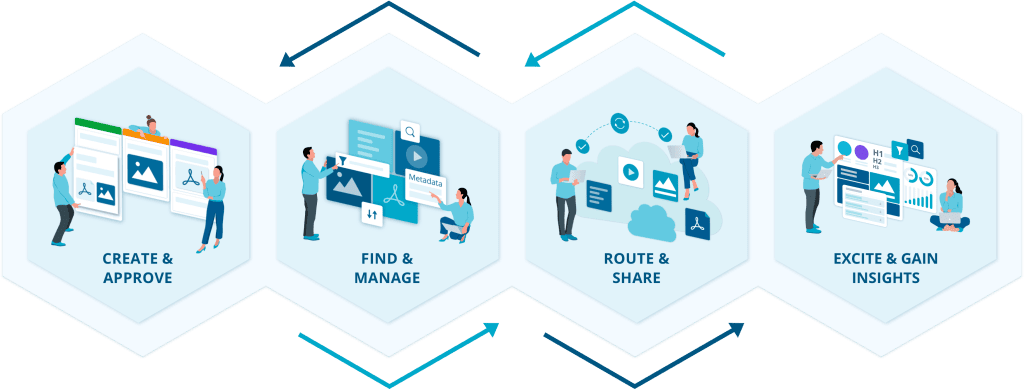
To enable AI agents to make precise decisions, teams must collaborate seamlessly on content creation and review. Efficient content collaboration ensures only verified information reaches agents. The technical foundation is a holistic content supply chain platform that centrally manages and versions all assets as a system of record.
How to Become Visible to AI Agents
The good news: you don’t have to reinvent everything – but you do need to adapt existing processes. Key levers include:
- Use structured data consistently: Schema.org markup, JSON‑LD and clear product attributes help agents understand your content.
- Take alt texts and image metadata seriously: AI agents don’t “see” images like humans; they require descriptive, information‑rich text.
- Write clear, machine‑readable copy: Avoid flowery marketing language; focus on precise, factual descriptions with tangible benefits.
- Establish GEO as a discipline: Generative Engine Optimisation is not the same as SEO, but it is built upon it. Organisations that start now and make their website AI-ready will secure a sustainable competitive advantage.
- Implement content governance: Using AI for content creation requires clear approval workflows. A system of record is mandatory.
Metadata management in digital asset management: centralised display of asset information, AI tags, language details and licence data for marketing content.
AI agents do not read websites – they consume data streams. To increase visibility, product data must be accessible via clean interfaces. Professional application integrations ensure content from the DAM flows directly into the channels most frequently evaluated by AI agents and generative engines.
What Companies Should Do Now
It would be wrong to say agentic commerce is already everywhere. It would be equally wrong to assume there is still plenty of time. The transformation is happening gradually – and companies that start now will gain a clear advantage later.
Concrete steps to take:
- Audit your product data: Is it complete, structured and machine‑readable – or still reliant on attractive images and vague descriptions?
- Review your content supply chain: Where is content created? How is it approved? Who is accountable if AI‑generated content is incorrect?
- Start with GEO: Early tools already assess how well websites are optimised for generative engines. Understand where you stand.
- Invest in clean data processes: Correct, complete and versioned product information is the foundation of everything.
The transition to agentic commerce requires a rethink in production. Companies must find ways to reduce content production costs and accelerate time‑to‑market to meet the growing demand for machine‑readable content.
For a deeper strategic dive, our ultimate guide to content supply chain management helps set the organisational course for the AI era.
Outlook: First the US, Then Europe
Agentic search is not a distant future scenario. Momentum is building – and it will fundamentally reshape e‑commerce and lead generation. As with many technology trends, the US is leading the way. Agentic shopping is already being actively tested there – from travel bookings and grocery shopping to complex B2B procurement.
Europe will follow, but with a delay. Stricter data protection, different consumer behaviour and slower adoption rates in SMEs all play a role. At the same time, the EU AI Act is laying down regulatory foundations that will also govern agentic AI.
The implication is clear: European companies still have some time – but not unlimited time. Those who start today can position themselves as first movers before external pressure mounts.
FAQ on Agentic Search, Agentic Commerce and Lead Generation
What is agentic search?
Agentic search is an evolution of search in which AI agents autonomously break down complex queries and combine information from multiple sources. Instead of merely delivering links, the system proactively researches, compares data and presents a complete solution or analysis.
What is agentic commerce?
Agentic commerce describes automated transactions where AI agents autonomously make purchases or negotiate prices on behalf of users or companies. Agents interact directly with platforms or other AIs to manage the entire process from selection to payment without human clicks.
What is agentic marketing?
In agentic marketing, autonomous systems proactively manage campaigns, lead qualification or customer interactions within defined goals. These agents react in real time to market changes and independently adapt strategies.
What is an example of agent‑based search?
One example is travel planning via an AI agent: you specify destination and budget, and the agent checks flights, filters hotel reviews and creates a complete itinerary including booking options. Systems such as Perplexity or specialised travel assistants already work this way.
Is ChatGPT an agent‑based AI?
In its standard form, ChatGPT is primarily a generative AI that responds to prompts. With features like “Actions” or the specialised “Operator” mode, it can however perform agent‑based tasks by autonomously using external tools across multiple steps.
What are examples of agentic AI?
Examples include autonomous coding agents such as Devin, which identify and fix software bugs independently, or AI‑driven supply chain managers that monitor inventory and trigger reorders. Smart home systems that proactively optimise energy usage based on forecasts also fall into this category.
What is the difference between generative AI and agentic AI?
Generative AI focuses on creating content such as text or images and typically responds only to a direct prompt. Agentic AI uses that intelligence to act – planning, making decisions and using tools to independently achieve a higher‑level goal.