The way people search for information is fundamentally shifting. Instead of scanning search results, users are increasingly turning directly to AI agents – systems that research, evaluate and provide recommendations in the background, often without ever visiting a website.
What begins as a behavioural shift is evolving into a structural transformation: agentic e‑commerce and agentic lead generation – autonomous systems that purchase products or evaluate providers – represent the next stage of development. Traditional website traffic is losing relevance as a key success metric. Brand mentions in AI-generated responses are becoming the new currency of digital visibility.
This leads to a critical question: can an AI agent find, understand and cite your content – or are you effectively invisible to these systems? In other words: is your company website AI‑ready?
Table of Contents
What Does “Agent‑Ready” Mean for a Business?
Agent‑ready describes a state in which a digital presence is optimised for accessibility by AI systems. It is no longer just about human readability, but about machine usability.
The following guiding questions define the foundation of your website’s AI readiness:
- Can the site be found?
AI agents must be able to crawl and index the website without technical barriers. - Can AI agents read the content?
Content must be structured in a machine-readable way – not hidden in JavaScript-rendered layers or buried in unstructured PDFs. - Is the content citable?
Content must be clear, precise and authoritative enough for language models to identify it as a reliable source and include it in responses.
Forward-thinking organisations are already preparing their digital infrastructure for a future in which agents do more than simply retrieve information. They will initiate processes such as quote requests, product configurations and even purchases. Agent readiness is therefore not a one-off optimisation project but a strategic infrastructure decision. As a result, the centralised management and machine-readable delivery of assets through a Digital Asset Management (DAM) system will become indispensable.
Further reading: Would you like to explore automated image and data management in greater depth? For additional insights, read our article on AI in Digital Asset Management.
How Do AI Agents Consume Your Information?
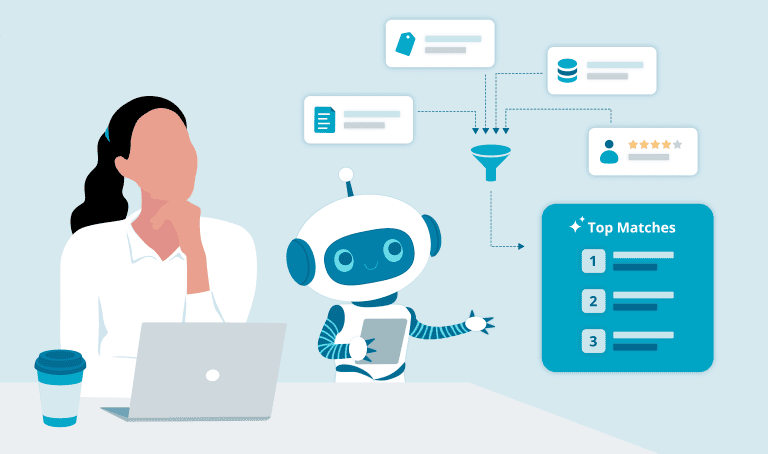
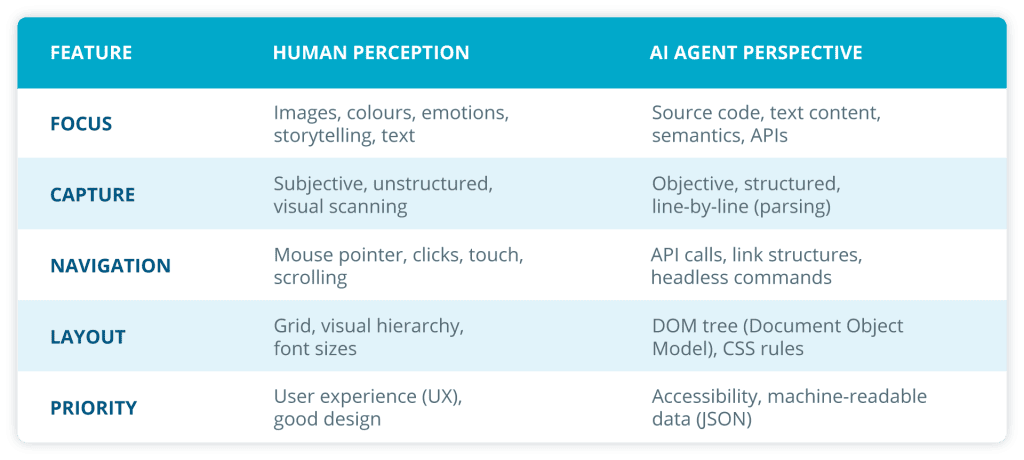
AI agents rely on modern mechanisms such as Retrieval-Augmented Generation (RAG). They search external sources in real time and extract relevant text passages as context for language models. Website design is irrelevant to them – they evaluate only meaning, clarity and consistency of text.
In agentic workflows such as agentic e‑commerce or lead generation, systems assess the entire brand presence. Consistency across all channels and the availability of structured product data are critical. A simple but precise page will outperform a visually impressive one that lacks structure.
What Are the Biggest Challenges to Your Visibility?
Most company websites were built for human users and are not truly agent‑friendly. This becomes evident when an AI agent attempts to interpret them. Common weaknesses include:
- JavaScript-heavy frontends: Many modern sites render content client-side using JavaScript. Crawlers often see only empty HTML shells because content loads afterwards. For an AI agent, the page effectively appears empty.
- Lack of structured data: Schema.org markup, OpenGraph tags and machine-readable metadata help agents categorise content correctly. Without these signals, systems must guess.
- Unclear content structure: Missing H1/H2 hierarchies, vague page titles or absent canonical URLs make it difficult for agents to identify key messages.
- Lack of authority: AI systems favour trusted sources. Missing backlinks, no author information and weak E‑E‑A‑T signals (Experience, Expertise, Authoritativeness, Trustworthiness) significantly reduce the likelihood of being cited.
- Inconsistent product data: For companies aiming to succeed in agentic e‑commerce, this is often the most critical issue: product information is scattered, outdated or incomplete – making it unusable for AI agents making purchasing decisions.
How Can You Build the Technical Foundation?
Technical agent readiness starts with fundamentals – many overlap with traditional SEO but go further:
- Ensure crawlability: robots.txt should explicitly allow AI crawlers. Known bots such as GPTBot (OpenAI), ClaudeBot (Anthropic) or PerplexityBot can be controlled individually. Blocking all bots makes your site invisible to AI.
- Server-side rendering (SSR): Ensure all content is available in raw HTML.
- Implement schema markup: Structured data using Schema.org enables agents to categorise content accurately – products, organisations, FAQs, articles, events.
- API-first infrastructure: With the rise of agent-based systems, the ability to deliver content and product data via clean APIs becomes a key differentiator.
- Headless DAM systems deliver assets in a machine-readable format and form the backbone of content distribution.
- Clean URL structures and core web vitals: Clear URLs, proper canonical tags and fast load times reduce noise – AI agents have no tolerance for slow or duplicate content.
How Can You Make Your Content AI‑Ready?
Technical accessibility is only the first step – content quality determines whether your content is cited and included in agent-driven workflows.
- Semantic clarity: Each page should address a clear, answerable question. AI agents extract key insights – vague content will not be cited, precise answers will.
- FAQ structures: Question-and-answer formats are ideal for RAG systems, providing compact, citable information blocks.
- Define clear entities: Establish your brand and products consistently as clearly defined entities.
- Authority through depth: Superficial content is deprioritised. Detailed, evidence-based content with data, case studies and expert insights signals reliability.
Agent‑ready content is not created through one-off optimisation but through systematic processes. Organisations that centrally manage content, enrich it with targeted metadata for AI-powered search and distribute it across channels in a controlled manner create the foundation for scalable agent readiness.
Why Is It Worth Investing in Agent Readiness?
This shift is not theoretical – it is already happening. Companies investing today in machine-readable data and technical accessibility gain an exponential advantage. While competitors still focus on traditional traffic, you are already positioned as an authoritative source in AI‑generated responses.
The question is no longer whether AI agents will find your brand – but whether your infrastructure is ready to interact with them.
FAQs on Agent-Friendly Websites
How does agent‑ready SEO differ from traditional SEO?
Traditional SEO focuses on rankings and clicks, while agent‑ready SEO prioritises delivering machine-readable facts directly. The focus shifts from website traffic to brand mentions in AI responses.
What is the most important technical factor for AI crawlers?
Clean server-side rendered HTML (SSR) without JavaScript barriers is essential. Combined with Schema.org markup, it allows agents to extract data reliably. Without this openness, your website remains invisible to AI systems.
Why is E‑E‑A‑T important for AI agents?
AI models use E‑E‑A‑T as a quality filter to avoid hallucinations and cite verified sources. Strong authority and proven expertise increase the likelihood of being recommended.
What role does content structure play in citability?
AI agents favour modular content and FAQ formats, as these allow easy extraction of information. Clear semantic hierarchies guide agents through content.
Can I block AI bots without losing visibility?
Blocking AI bots may protect your data from training models but also removes your presence from real-time recommendations. In the age of agentic commerce, full blocking can result in losing an entire sales channel. Targeted control is the better approach.