
The impact of a brand on a business’ success is irrefutable.
It’s practically impossible to refute the impact a brand has on a business.
A brand is what sends a strong quality and reliability signal about your products.
It can emphasize innovation of your products, their reliability, a proven track record or set you up from the competition.
Not to mention that a robust brand can provide a cushion during challenging times such as product recalls, supply chain disruptions, or regulatory issues.
And it’s not just our opinion, of course.
Jeff Bezos famously stated that a brand for a company is like a reputation for a person.
Steve Forbes, the editor-in-chief of the renowned publication noted: “Your brand is the single most important investment you can make in your business.”
Howard Schultz, former CEO of Starbucks said: “A great brand raises the bar – it adds a greater sense of purpose to the experience.”
Customers concur.
81% of consumers openly state that they need to trust a brand to even consider buying from it. (source) According to the same source, 77% of consumers prefer shopping with brands they follow on social media, suggesting that they know and at least somewhat trust those brands. But unfortunately, only 31% of consumers admit they trust most of the brands they use.
This last data point in particular suggests that there is still a significant gap between what customers expect and what companies deliver in terms of their branding.
In turn, it reveals that a large number of companies might still struggle with brand management.
So, with such findings in mind, we decided to evaluate what is the state of brand management today.
For that reason, we’ve conducted major research into how companies manage to present a consistent image across all channels.
We’ve shared some of our findings below.
Before we get to the good stuff, though, let’s recap the concept of brand management.
Table of Contents
What is Brand Management?
When we use the term – brand management – we refer to strategic efforts to maintain a consistent brand image across all channels and customer touchpoints. Efforts that aim to deliver an instant recognition from customers, and a clear understanding of the brand’s values.
Note that we said, efforts. That’s because brand management isn’t a singular process. A thorough brand management strategy would, typically, involve various activities ranging from brand positioning, identity development or brand communication to brand asset management, and more. And even those activities can be broken down into several other activities.
In other words, brand management is a combination of various processes leading to similar goals: Increased brand awareness, loyalty, or greater market differentiation.
In our research, we focused on evaluating how companies manage that combination of processes, from the structure of their team, to challenges that prevent them from building strong and memorable brands.
This has allowed us to better understand the state of brand management today.
Brand management adoption varies greatly across industries.
Naturally, no report will paint the full picture of the adoption of such complex processes as brand management across all industries.
Our research is no different. After all, we’ve mostly branding specialists without our sphere of influence to participate. However, even such a limited sample set allowed us to paint a strong picture of what types of industries tend to invest in brand management the most.
In our sample set, the manufacturing industry clearly led the pack.
38% of manufacturing companies that participated in the research admitted to investing and focusing on brand management efforts. Services and retail followed with 18% and 12% respectively.
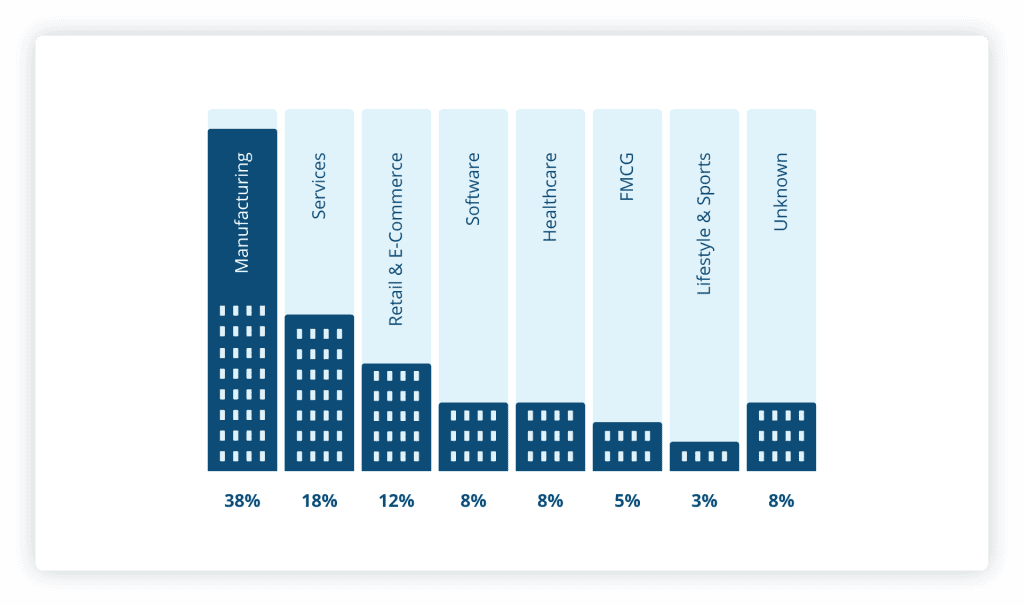
Interestingly, our research matches other similar findings.
For example, Verified Market Research report lists retail, healthcare, financial services and manufacturing as the largest adopters of brand management.
Another interesting fact about this data is that brand management does not seem to enjoy a high adoption in the tech industry, the actual largest one in terms of brand value.
According to the Brand Finance Global 500 index, tech companies make up to $1.3 trillion in brand value. Yet, they aren’t present among the top adopters of brand management.
The situation is different with the second most valuable industry in terms of brand value, retail. As ours and other research studies discovered, retail companies invest in brand management quite heavily.
Brand management looks more like a joint effort.
What’s more, the responsibility for overseeing brand management efforts is often distributed across several professions.
Our respondents, for example, ranged from marketing managers, brand managers, designers, content creators, and even salespeople.
Interestingly, brand managers didn’t form the largest groups. Only 20% of participating companies had a dedicated brand manager.
This might suggest that the position of a brand manager is still relatively new. Or that companies prefer to turn over the responsibility for managing the brand to the marketing team.
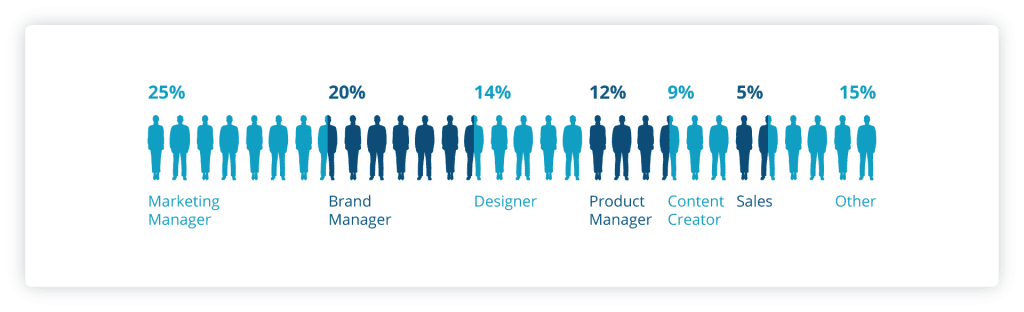
Interestingly, our brands match various expert opinions. In his article, Who is Responsible for Brand Management, branding expert, Mike Anthony recalls a panel discussion on the topic during which participants unanimously admitted that consumer marketing should be held responsible for brand management.
In the article, Anthony explains: “I have a belief that the only reason that there was such a strong consensus around the group that consumer marketers are in charge of brands is historical. For a long time consumer marketers have been called brand managers, and that’s just the way it has been.“
Another interesting data point to match this comes from WiserNotify. In their collection of branding statistics, the company shares that 10-20% of marketing budgets are spent on branding and rebranding by most companies. Based on this, we can deduce a lack of dedicated branding budget to oversee those efforts.
Now, whether this should change is open to debate. However, it is worth noting that, for now, the actual responsibility for brand management remains scattered across various professions.
The 2024 state of brand management tools in europe
Gain the latest insights into brand management with our 2024 Brand Management Survey! We surveyed marketing and brand managers from medium and large B2B and B2C organisations across Europe to understand the current state of Brand Management tools – and the results are insightful.

Brand management activities vary between companies.
This particular finding isn’t entirely surprising. After all, brand management in itself consists of several different areas of focus.
First, there are two different types of brand management:
Strategic brand management – The process of overseeing and developing a brand to ensure it aligns with business objectives and resonates with the target audience.
Strategic brand management involves creating a unique brand identity, communicating it effectively, and consistently monitoring and adjusting strategies to maintain a strong brand reputation and competitive advantage.
Digital brand management, on the other hand, is the process of maintaining and enhancing a brand’s presence in the digital realm.
This process involves using online marketing channels – social media, website, online advertising, content, and more – to communicate the brand’s identity effectively, engage with the target audience, and manage its reputation.
Then, activities across brand management efforts vary greatly, too.
In general, however, according to Gartner, companies invest about 9.7% of their marketing budget into brand strategy. As the company states in the report:
“This indicates a return to marketing’s core value proposition: to build awareness and engagement with compelling brand marketing and effective campaigns that connect with customers to deliver results.“
Salesforce suggests approximately 10-20% of marketing budgets to be allocated to brand awareness.
However, this data suggests that brand management doesn’t seem to play as critical role in the company’s overall marketing, with higher budgets being dedicated to other aspects of promotion.
It's hard to manage a brand without dedicated tools.
Naturally, it would be impossible to manage something as complex as a brand and its consistent representation without at least some software. And needless to say, this is where our findings become particularly interesting.
First of all, in spite of the existence of dedicated brand management platforms, only 3% of our respondents admitted to be already using such a tool.
Most (26%) utilise a digital asset management platform to manage brand assets.
24% try to do it with a combination of various Microsoft Office or Google Workspace tools, while another 22% employ cloud services (i.e., Adobe).
Interestingly, 6% of respondents admitted to having no specific tool at all to manage brand assets!
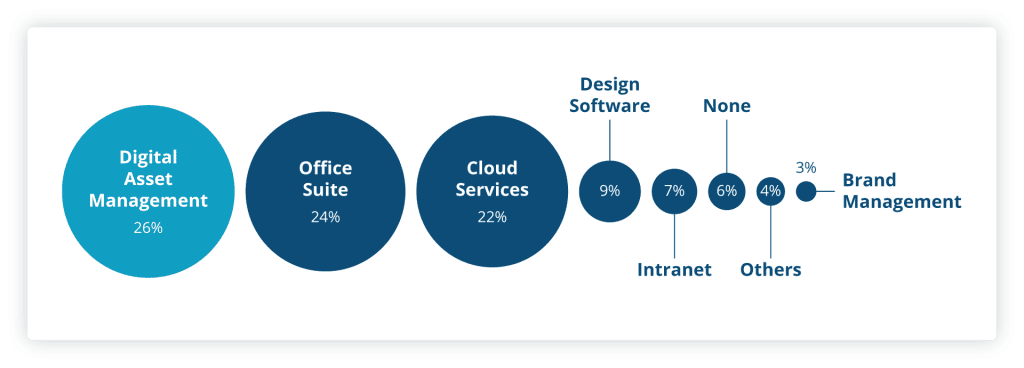
Our findings differ slightly from other available sources. However, all research confirms that only less than 10% of companies turn to integrated brand management solutions like CELUM offers, that combine DAM features with additional features like collaboration, analytics, and more.
According to this research by Verified Market Research, 35% of companies use general purpose tools like Google Workspace or Microsoft Office. 25% invest in a DAM platform, and only the aforementioned less than 10% use dedicated platforms.
But, as it turns out, companies aren’t fully satisfied with their current stack.
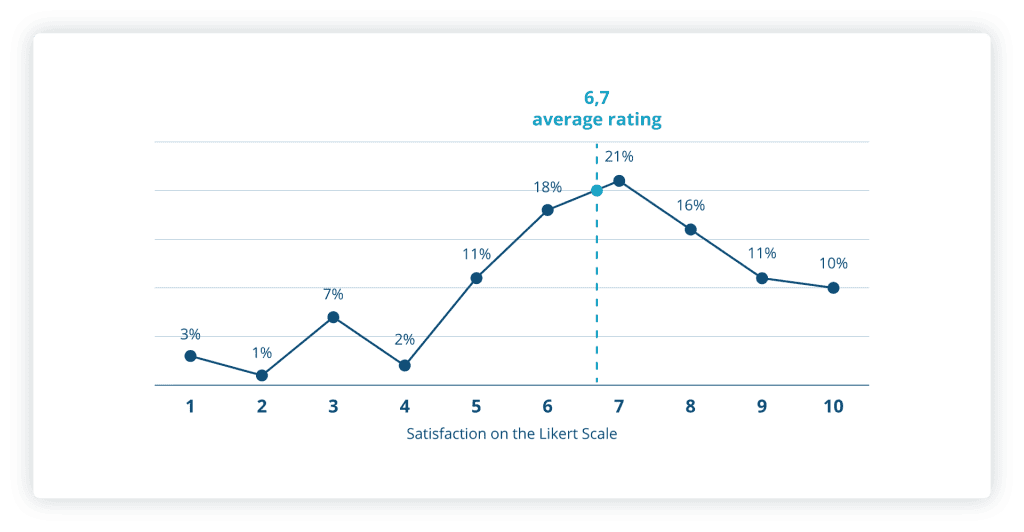
Our research revealed that the average satisfaction with the current tools is only 6.7.
Another interesting, and highly encouraging aspect of brand management we’ve discovered is the frequency of turning to those processes and tools.
According to our findings, 54% of companies turn to their brand management processes and tools daily. 26% do so weekly, and only 8% occasionally perform actions within their brand management platforms.

This matches other available research points suggesting that 70% of creative and marketing teams access brand management tools daily, and 20% use them on weekly basis.
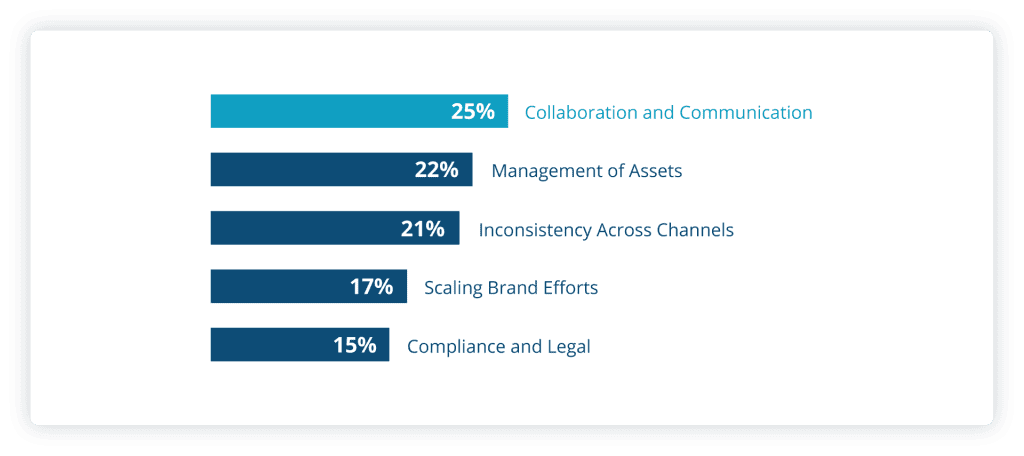
For brand management, limited collaboration and communication opportunities cause the most problems.
It has to be said, we weren’t particularly surprised by this finding.
After all, the vast majority of companies are not using dedicated brand management platforms yet. The circumstance, that respondents are missing critical features and capabilities, only makes sense. Traditional, DAM-only tools, Office suite platforms, etc. offer limited set of capabilities to cover the entire spectrum of brand management.
- They often lack dedicated collaboration and communication features, something that 25% of our respondents lack.
- Aside from DAM, these solutions do not offer a way to properly manage a large scale of brand assets. And 22% of our respondents mentioned difficulties in asset management preventing them from availing of the full potential of brand management.
- To 17%, the biggest challenge was maintaining consistency across channels. Needless to say, this issue can easily be attributed to challenges with communication and collaboration. After all, with teams working on projects in silos, maintaining consistency is almost impossible.
- The same goes for another challenge that 15% of our respondents highlighted – difficulties in scaling branding efforts. A lack of a dedicated platform can easily result in chaos in the process, and many projects being unsuccessful or even halted altogether for various reasons.
Want to learn more?
Then download our The 2024 State of Brand Management Tools in Europe report.
Need to take your brand management to the next level?
Our brand management platform, CELUM, offers all the features and capabilities to help you:
- centrally manage branding features such as logo, colours, visuals
- manage feedback and approval workflows
- manage brand guidelines
- enable everyone to use branding features correctly
- share brand assets safely through dedicated Portals, and more.
Learn more about CELUM’s Brand Management Software.