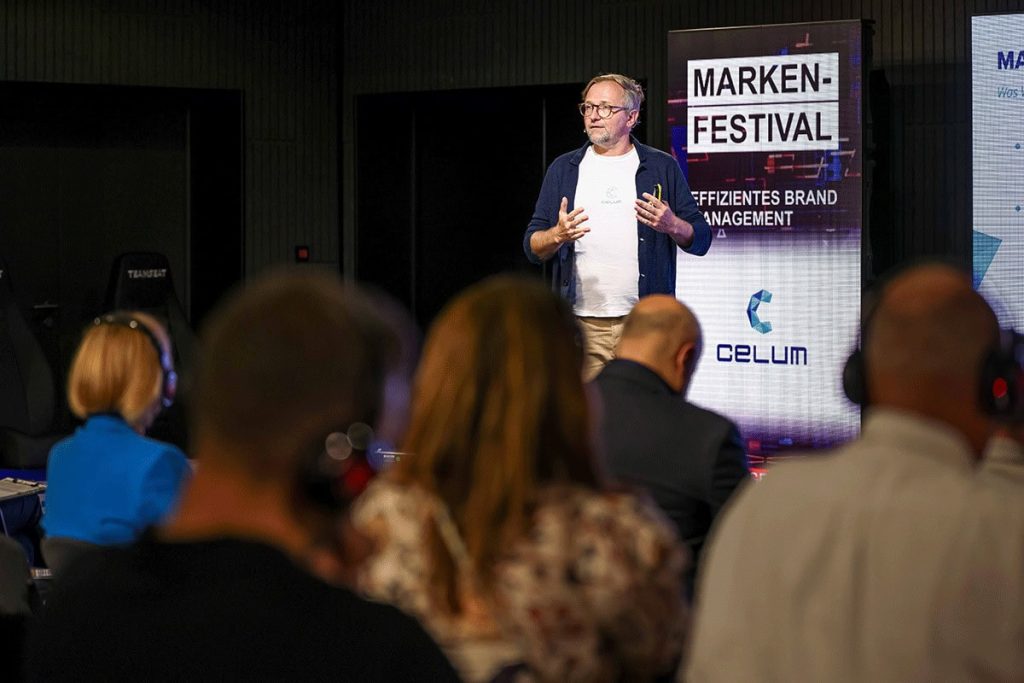
Under the motto ‘Branding needs Influence’, the Markenfestival at the MERKUR SPIEL-ARENA Düsseldorf attracted more than 400 brand experts and media representatives. The CELUM Forum was a particular highlight, with Magenta Telekom providing insights into how CELUM as a central tool helps to optimise content supply chains and ensure a consistent brand experience.
You can find out more about how brand management can work in the manufacturing and retail sector and how Magenta Telekom is using CELUM in its brand processes in the following summaries of the presentations:
Brand management for mid-sized companies in the industrial and commercial sectors
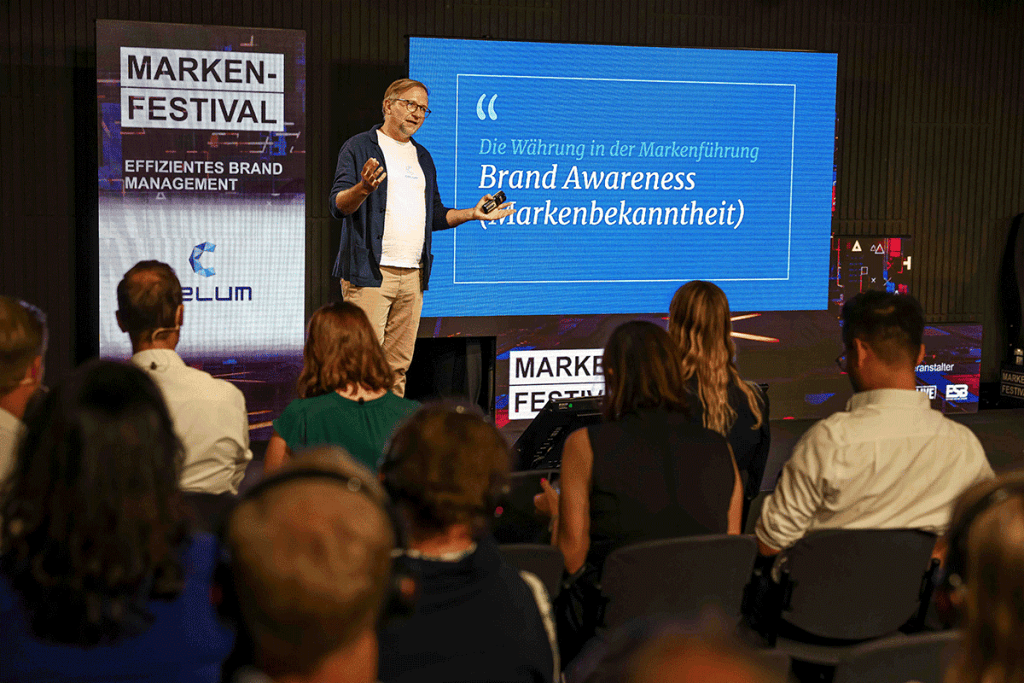
Michael Kräftner, founder and CEO of CELUM, opened the forum and provided important insights into brand management for industry and trade in his presentation ‘Brand management for industry and retail – efficient brand management even if it is not featured on every Coke bottle’. He made it clear that even companies with smaller budgets can establish strong brand management if they consistently implement the right measures.
Problem:
Brand management is a challenge for companies in the manufacturing and retail industries, especially for mid-sized businesses. While large corporations have huge budgets to promote and consolidate their brands, smaller companies with fewer resources often struggle to establish and maintain a consistent brand presence. Multinational markets and multiple distribution channels add to the complexity.
Solution:
A key solution for effective brand management in this complex environment is brand consistency. This means that the brand identity must remain consistent across all channels and markets in order to build trust and recognition among customers. A good example of this is Coca-Cola, which has maintained a consistent brand image for decades, setting it apart from competitors such as Pepsi.
This is particularly demanding for medium-sized companies, as they often work with limited budgets and resources. One way to overcome this challenge is to implement a central brand management system that effectively supports internal and external stakeholders (employees, channel partners, agencies). This can be achieved through solutions such as the CELUM Content Supply Chain Management platform. This serves as a platform to engage all those involved in managing the brand and to ensure consistent content across all channels.
Five key solutions:
- Brand empowerment: Delivering the brand as an internal service, giving employees and partners the tools they need to use the brand consistently.
- Targeted content delivery: Relevant content is distributed to the right audiences and channels to communicate the brand effectively.
- Product content is king: Product content itself plays an important role in brand management, especially in the manufacturing industry. Products should be viewed as brand ambassadors.
- Working effectively with external stakeholders such as agencies: It is important that external stakeholders – such as marketing agencies – understand the brand guidelines and can implement them consistently. This avoids misunderstandings and unnecessary delays.
- Democratise content creation: Tools and platforms should enable everyone in the organisation – from employees to channel partners – to easily create branded content in a controlled manner.
Result:
Companies that successfully implement these solutions can improve brand management, reduce time to market and ultimately strengthen their market position against larger competitors. By managing their content supply chain as carefully as their physical supply chain, they can be more agile and successful.
Marketing communications transformation: from silos to transparent collaboration
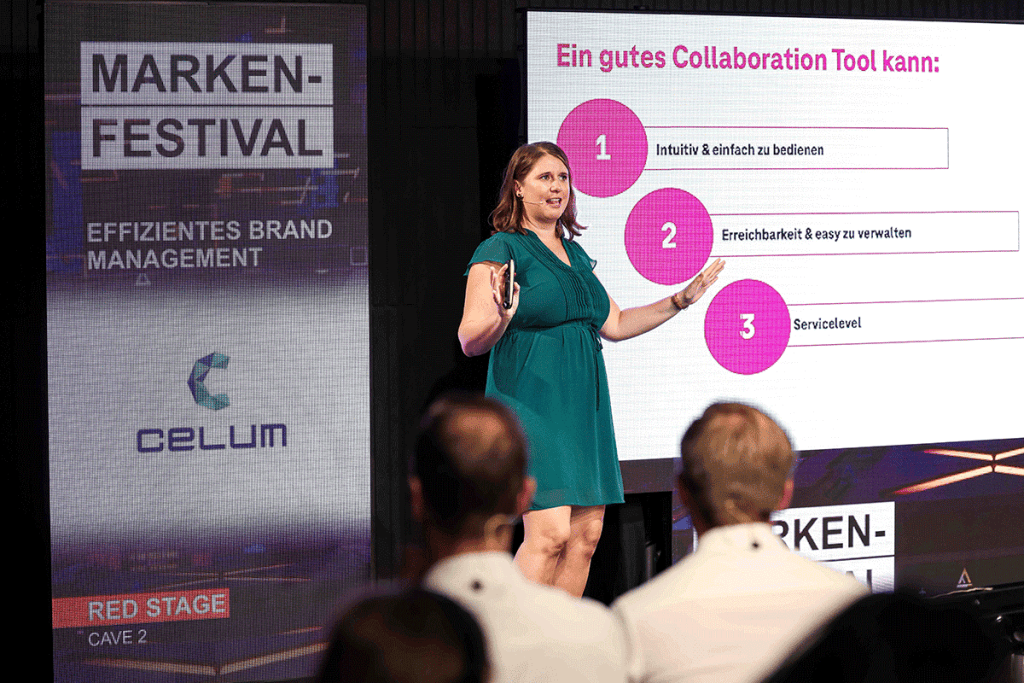
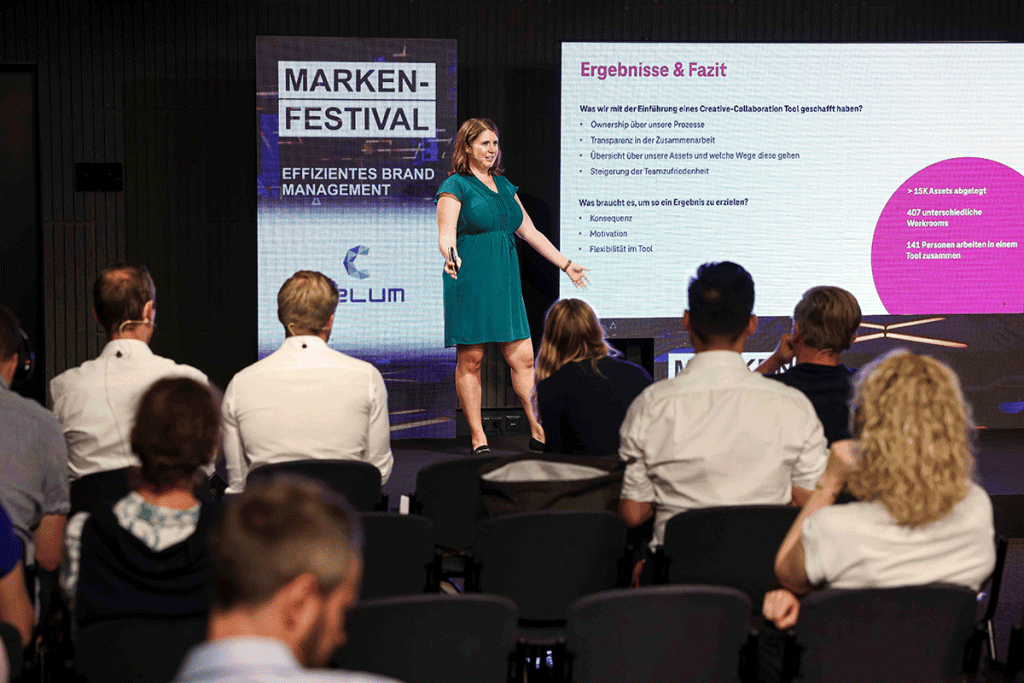
In her keynote speech ‘Transformation of marketing communication: from silos to transparent collaboration’, Nina Mack, Head of B2C Brand Communications at Magenta Telekom, explained the profound transformation that her team has undergone. The presentation highlighted the challenges in modern marketing communication, which is characterised by a sharp increase in the number of advertising measures and an increasingly complex communication landscape. Mack’s team, which operates in a fast-moving industry, was faced with the task of developing more efficient processes to meet the increasing demands.
CELUM Creative Content Collaboration for effective collaboration
A key step was the introduction of the CELUM Creative Content Collaboration solution, which enables transparent and agile collaboration within the team and with external partners. Old structures, such as email communication or storing data on servers, often led to friction and inefficiency. The new tool has not only enabled the team to streamline workflows, but has also increased transparency and mutual trust.
Workflows help
A key aspect of the change has been adapting routines and workflows. Mack emphasised that by analysing and redesigning their own processes, the team was able to work more efficiently and break down silos. The introduction of clear rules – such as only using this tool for tasks and feedback – led to a significant improvement in collaboration.
Results:
The results speak for themselves: 141 people are now successfully working together in 407 workrooms, 15,000 files have been stored centrally in the system, and team satisfaction has risen to 100 per cent. This transformation to an open, transparent working environment shows how the targeted use of technology can not only achieve efficiency gains, but also sustainably improve team culture.
Conclusion: CELUM, the key to efficient brand management
The presentations at the Markenfestival showed that CELUM is much more than a simple tool for managing brand assets. It is a crucial building block that helps companies such as Magenta Telekom to optimise their brand management, improve internal collaboration and create a consistent brand experience across all channels.
Find out more about how CELUM can help your business optimise brand processes and gain full control over your content supply chain. Visit www.celum.com for more information – and take your brand management to the next level!