For years, marketing has focused on creating the perfect touchpoints for people. But what happens when customers no longer search, compare and click themselves, and autonomous AI agents take over those tasks?
With Agentic Shopping and Agentic Lead Generation, the customer journey is shifting dramatically: away from compelling presentation and toward machine-readable product data. If you cannot provide AI agents with complete and reliable facts, you may be eliminated during the initial evaluation stage. In this article, you’ll learn how AI is transforming the journey phase by phase and how to make your data foundation agent-ready.
Table of Contents
What Fundamentally Changes in the Journey: Delegation Instead of Navigation
The traditional customer journey assumes that a person moves through every phase independently: searching, clicking, comparing and deciding. Brands design the touchpoints where they can influence these decisions, such as advertisements, websites, consultations and online stores. One clear and noticeable shift in the customer journey can already be seen in Google’s new AI Search Box. Search is becoming more dynamic, with Search Agents continuously performing research in the background.
This evolution will continue. With AI agents, the division of responsibilities changes. People define the goal, criteria and constraints, such as a budget. The AI agent handles the individual tasks across multiple systems. It answers questions, personalizes content and completes actions. It operates across the entire journey rather than at a single touchpoint.
As a result, the place where a brand exists also changes: no longer only where people look, but where agents retrieve data.
The Journey Phase by Phase: What the Agent Does and What the Brand Must Deliver
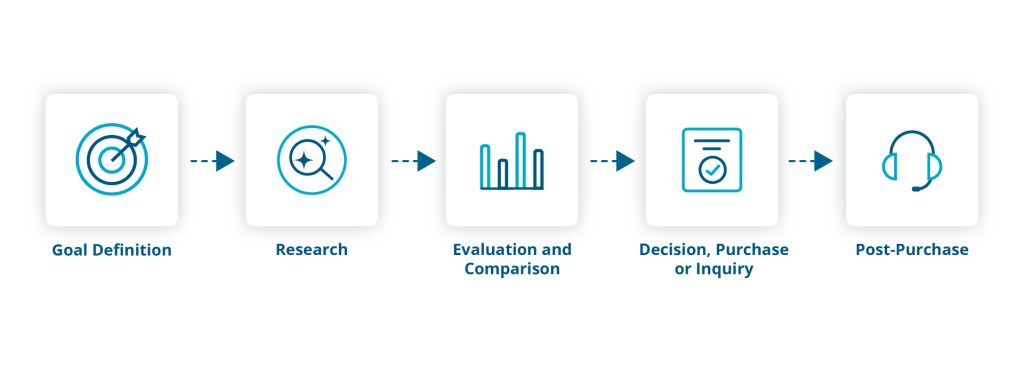
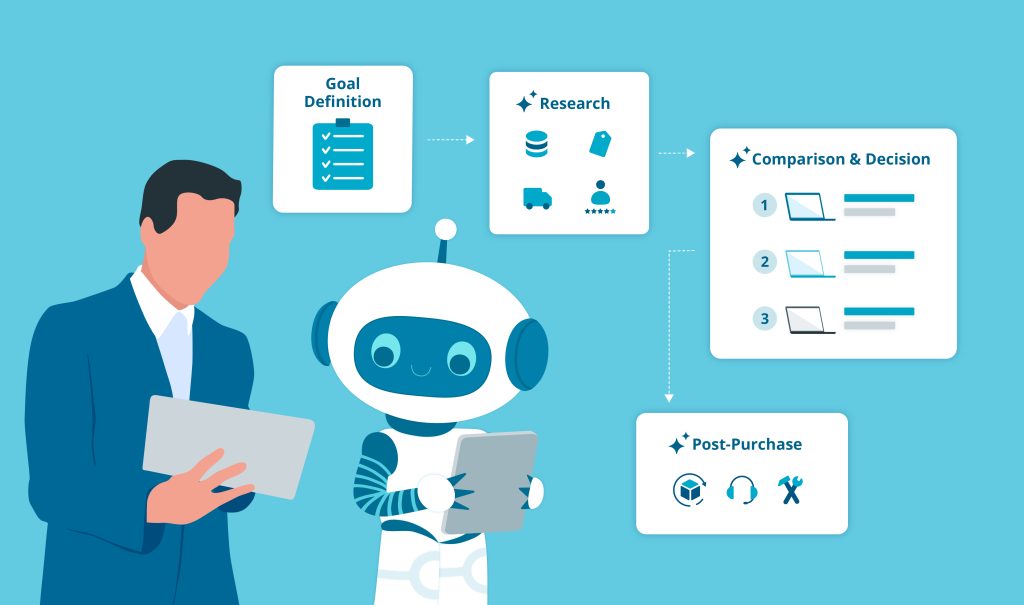
Need Recognition and Goal Definition
Today, the journey often begins with a search query. In the future, people will define complex tasks instead. For example, finding laptops for a mobile workforce, within a specific budget and with delivery before the end of the month.
A brand will no longer be discovered through a keyword alone, but through its ability to meet and validate these requirements. Product data must therefore reflect the information customers actually search for: compatibility, delivery times, material characteristics and commercial terms.
Research
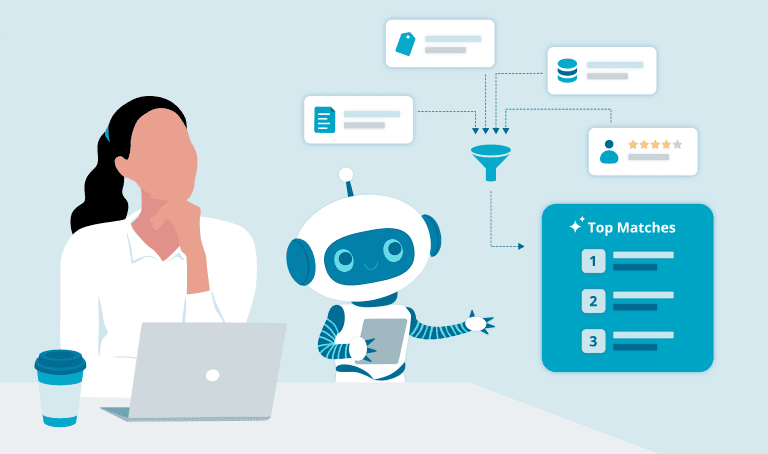
The agent breaks the task into smaller questions and retrieves product data, documents, reviews and vendor information.
Website design and layout provide little value to an AI agent. Structure and clarity matter instead. Discoverability therefore becomes a data accessibility issue: content must be crawlable, structured and unambiguous.
Incidentally, you can learn how to make your company website AI-ready and how metadata helps AI systems understand, categorize and surface your content in relevant searches in our blog section.
Evaluation and Comparison
This stage brings the greatest behavioral change.
People are influenced by imagery, tone of voice and brand identity. An agent, by contrast, compares requirements with available information: attributes, terms, availability and references.
If information is missing, the agent cannot properly evaluate the offer. A data gap is therefore not merely a disadvantage; it may become a reason for exclusion.
At this stage, the brand influences outcomes indirectly through the completeness, consistency and traceability of its data.
Decision, Purchase or Inquiry
The AI agent acts within the scope of its assigned authority.
For standardized purchases, it can complete the process autonomously through checkout. For complex products and buying scenarios, the agent presents a highly refined shortlist to a human decision-maker.
This is where the brand comes back into focus: the human now decides based on trust, experience and overall brand perception.
If the brand has not demonstrated enough value by this point, it may never make it onto the shortlist.
Post-Purchase
Reorders, complaints and service requests are increasingly handled through AI agents.
Documentation, user guides, warranty terms and return policies therefore need to be available in machine-readable formats. Otherwise, the customer journey ends at the exact point where it should be creating loyalty.
A centralized download center for technical documentation keeps all relevant information current and accessible.
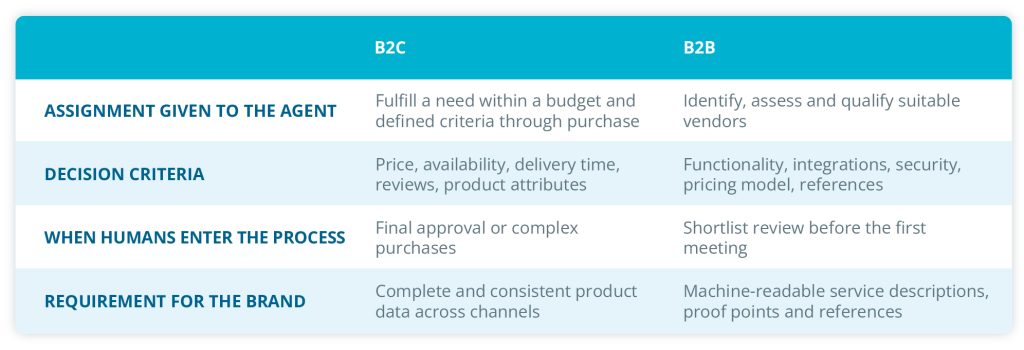
How Does the Agentic Journey Differ Between B2C and B2B?
In B2C, purchase decisions for standardized and recurring needs are increasingly delegated. Visiting an online store becomes a transaction executed by an agent on behalf of the customer.
In B2B, qualification takes place before the first conversation. The agent evaluates requirements across multiple stakeholders, including engineering, procurement and compliance, before sales becomes involved.
Sales teams enter later in the process but engage with prospects who are significantly better informed.
Which Parts of the Customer Journey Remain Human?
Some purchases still require human involvement. People may want to see a product, experience it in person or receive advice before making a decision.
As a result, hybrid journeys are often created, where the agent performs the initial screening and the human makes the final choice.
Brands therefore need to serve both worlds simultaneously using the same source of truth. If information differs between a store, datasheet and customer portal, the brand contradicts itself.
Consistent Brand Guidelines for a stable brand presence help ensure a consistent perception.
How Does Modern Journey Management Work in the Age of AI?
Traditionally, journey management involved mapping customer journeys, identifying pain points and implementing improvements through projects. These snapshots often became outdated quickly.
Agents change this logic.
Because agents coordinate activities across multiple systems, the focus shifts away from individual interactions and toward overall outcomes.
Companies are deploying their own agents in areas such as customer service and lead qualification while simultaneously interacting with the agents used by their customers.
Journey management therefore evolves from periodic analysis into continuous orchestration.
Rather than revisiting journey maps at fixed intervals, teams continuously identify breakdowns and respond to them.
Human responsibility does not disappear. Instead, it changes.
People determine the objectives of their agents, establish boundaries for autonomous behavior and remain accountable for outcomes.
These guardrails are not static rules. Organizations refine them as they observe how agents behave in real-world scenarios.
This requires data, systems and processes to be connected, accessible and governed. Otherwise, an agent sees only an isolated touchpoint instead of the entire journey.
How Do You Measure the New Agentic Journey?
Traditional analytics focus on clicks, sessions and conversions.
An agent generates little of this familiar activity, and exclusion during a pre-selection process leaves no visible trace.
Organizations that only measure traffic and conversion rates therefore see only part of the journey while assuming they are seeing the whole picture.
More meaningful supplementary indicators include:
- Brand mentions in AI-generated answers
- Visits from AI crawlers
- Completeness and consistency of data across all channels
Measurement methods are still evolving, but the shift in mindset must begin now.
What Does an Agent-Ready Customer Journey Require?
An AI agent can only use information that is accessible, structured and consistent.
If product information and assets are scattered across multiple systems and maintained at different levels of accuracy, the agent sees conflicting information and may fail to evaluate your offering altogether.
For marketing and e-commerce teams, the key questions are:
- Where is the authoritative dataset that applies across all channels?
- Who approves it?
- How can it be delivered accurately to every touchpoint an AI agent might access?
The answer is a centralized, reliable source of truth.
This is precisely where CELUM’s DAM software helps make your content agent-ready:
- No more data silos: A structured Content Supply Chain consolidates all product content, media assets and documents into a central system of record, ensuring agents do not encounter outdated information.
- Quality assurance before publication: Through Content Collaboration, approval workflows are enforced so that only verified and accurate information is published.
- Structured product data: Product Content Studio prepares content according to governance standards and seamlessly connects assets with the metadata and attributes that AI agents rely on.
- Seamless data distribution: Application Integrations automatically distribute verified information to PIM systems, webshops, portals and other channels. When an AI agent searches, it finds the same consistent version of your brand everywhere.
Conclusion: The Journey Is Shifting
The customer journey is not becoming shorter or irrelevant. It is shifting from touchpoints to structured data points.
Organizations with centralized, complete and approved product data will secure their place in AI-driven shortlists.
Want to make your content and product data agent-ready? Our solutions can help.
FAQs About Agentic Shopping, Lead Generation and the Customer Journey
How Does Agentic Shopping Change the Customer Journey?
Agentic Shopping shifts research, comparison and parts of the buying process from humans to AI agents. People define objectives, criteria and budgets, while agents evaluate options based on available data. As a result, websites and online stores may be visited less frequently.
What Does Agentic Lead Generation Mean for B2B Sales?
Vendors are qualified before the first interaction takes place. Sales teams become involved later but engage with prospects whose requirements have already been evaluated. Organizations excluded from the shortlist will never receive an inquiry.
Do Touchpoints Become Irrelevant?
No.
Many people still want to conduct their own research, seek advice or experience products in person. Hybrid decision-making is common.
Brands therefore need to serve both human touchpoints and machine-readable data channels simultaneously.
How Can Success Be Measured If No Human Visits the Website?
Traditional metrics such as visits and conversion rates only partially reflect agentic journeys.
Additional indicators include brand mentions in AI-generated responses, activity from AI crawlers and the completeness and consistency of data across channels.