“Find me enterprise Digital Asset Management software with automated AI tagging, servers located in the EU and an annual budget of less than €20,000.” A single prompt sets complex processes in motion. What happens next remains a black box for many companies. This creates risks: if you do not understand the research and evaluation logic of an AI agent, you cannot optimise your content effectively and risk losing digital visibility.
Our article on Agentic Search and lead generation highlights this shift: people are moving from active searchers to task-setters. The following article opens up the black box and explains how AI agents filter data and which factors determine whether your company makes it onto the shortlist.
Table of Contents
What Is the Difference Between Automation, LLMs and AI Agents?
Before looking at the individual stages, it is worth making a distinction that is often blurred in practice. Three categories of systems are frequently grouped together, even though they work in fundamentally different ways and therefore place different requirements on company content.
How Does a Traditional Automation Tool Work?
A traditional automation tool, such as a standard chatbot, follows rigid rules: if X happens, Y follows. A script searches predefined data sources for predefined patterns. If the website structure changes, the process breaks down. These systems offer high levels of stability but no flexibility whatsoever.
What Can LLMs Such as ChatGPT or Perplexity Do?
Large Language Models (LLMs) process natural language, combine information and generate well-founded answers. Perplexity focuses on real-time web search with source citations, while ChatGPT primarily draws on training data and optional web searches. By default, the process ends with information: the final decision is still made by a human.
Specialised agent modes extend beyond this boundary. Through additional functionality, language models can operate external tools, complete forms and execute multi-step workflows. The transition to Agentic AI therefore depends on the operating mode being used.
What Defines a True AI Agent?
A true AI agent differs from traditional automation and LLMs operating in standard mode because of what happens after the research stage. It is not given a rigid set of rules or a simple information request, but a goal. From this goal, it independently determines which steps are required, how to respond to unexpected situations and when to take action rather than simply report back.
If it cannot find structured product data on a page, it independently looks for alternatives: a datasheet, an API or another source. The result is not necessarily just an answer, but potentially a completed action, such as a purchase, a booking or a contract enquiry.
An Example: Automation vs LLM vs AI Agent
A marketing team is looking for a system to centrally manage product images, approval processes and brand data.
- The automation script compares providers from three predefined software comparison portals and produces a table. A specialised Digital Asset Management system that is not included on this list remains invisible.
- Perplexity searches the web for the best solutions, summarises sources and identifies providers such as CELUM. The team then evaluates the list manually.
- The AI agent is given the task: “Find and contact the three best providers of a Content Supply Chain platform with an approval workflow and API integration.” It independently checks the structured product data of multiple providers, including information about Content Collaboration or Application Integrations, filters according to data quality, creates a ranking and, if appropriate, even sends a contact request automatically.
The 5 Stages of AI Agent Research
AI agents operate flexibly, but follow a clear pattern. At each of the five stages, it is determined whether your company remains within the agent’s search criteria.
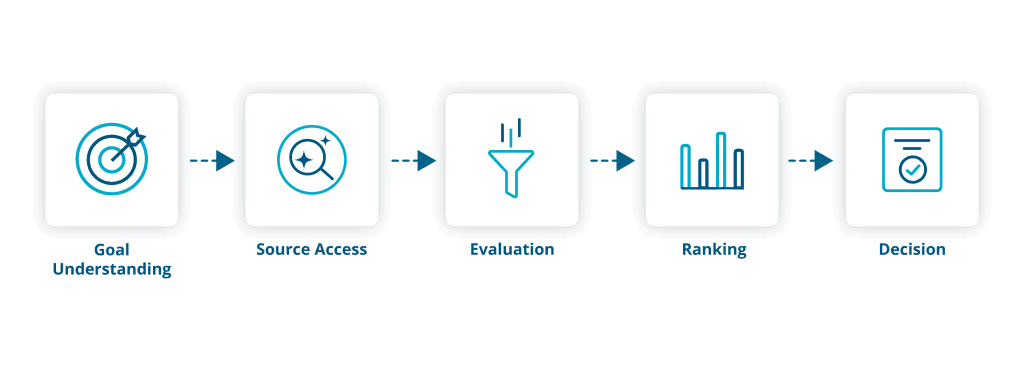
Stage 1 – Goal Understanding
Before an agent even begins searching, it translates the task into specific, machine-processable criteria. “A reliable supplier under €5,000” becomes a structured request with a budget limit, delivery time frame and implicit exclusion criteria such as minimum review scores or certifications.
This stage takes place entirely within the agent, meaning companies have no direct influence over it. Nevertheless, it is highly relevant: only companies that subsequently describe their offerings according to these exact criteria will be recognised as a suitable match.
Stage 2 – Source Access
This is where the actual research begins. How exactly this works depends on the AI model and the task it has been given. While some agents rely on their pre-trained knowledge base (a static index), others increasingly use real-time web searches or interfaces to retrieve current data live.
Whether through live search or an index query, this is where the biggest difference compared with human search becomes apparent: an agent does not click through navigation menus, read hero headers or allow itself to be persuaded by an attractive image. Instead, it specifically accesses structured data sources such as Schema.org markup, JSON-LD, open APIs, product feeds and PIM data.
Traditional landing pages that prioritise visual impact over machine-readable structure are often simply skipped at this stage. Not because the content is incorrect, but because the agent cannot access it in a usable form.
Stage 3 – Evaluation & Filtering
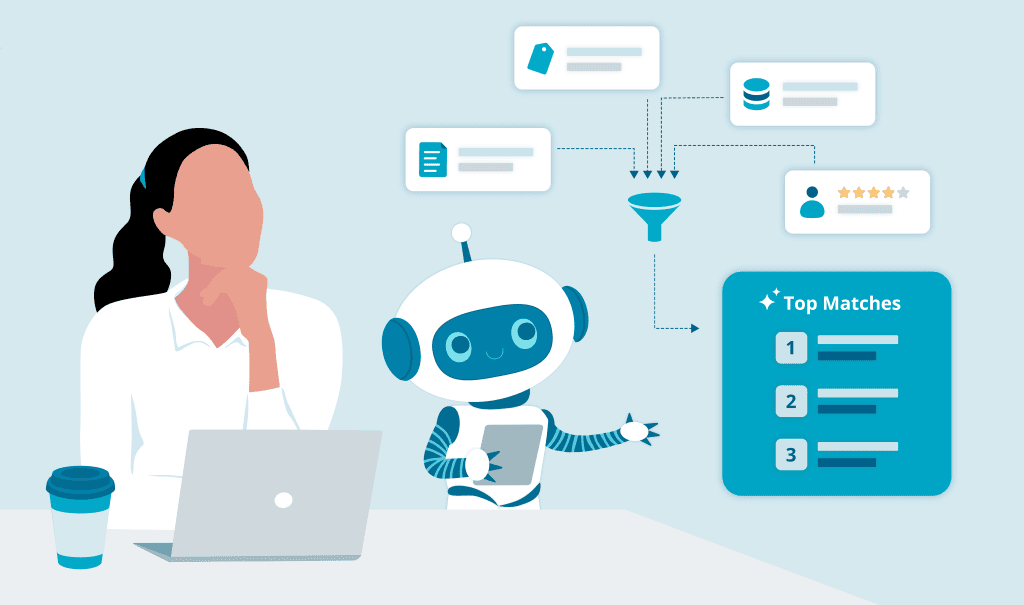
The agent now filters the sources it has found. What matters here is not marketing claims, but data signals: Is the information complete? Is it up to date? Is it consistent across different channels?
If pricing or availability information differs between the website, product feed and marketplace, the agent treats this as a source of uncertainty and may exclude the provider.
At this stage, data quality is not a nice-to-have. It is the central filtering criterion.
Stage 4 – Comparison & Ranking
The remaining candidates are now evaluated against one another. The agent applies weightings based on the criteria established in Stage 1, such as price, delivery time, reviews and specifications, and creates an internal ranking.
It is important to understand that this ranking is not based on awareness or brand strength in the traditional sense. Instead, it depends on how precisely and completely an offering meets the required criteria and how reliable the underlying data appears to be.
Stage 5 – Decision & Handover
The final stage results either in an autonomous action, such as a purchase, booking or contract enquiry, or in a shortlist handed over to a human, for example in B2B sales.
The same principle applies here: any company that reaches this stage has already been positively evaluated during the previous four stages.
There is no “second chance” through a human looking at the website. The shortlist has already been created before any direct contact takes place.
Where Can Companies Become Visible to AI Agents?
Each of the five stages offers a specific point at which companies can influence their visibility.
- In Stage 2, the technical accessibility of data is crucial. Structured markup and open interfaces are fundamental requirements.
- In Stage 3, consistency matters. Product data must match across all channels, which requires a central, version-controlled data source.
- In Stage 4, the completeness of attributes determines whether an offering can be compared at all. Missing values may be treated by the agent as grounds for exclusion.
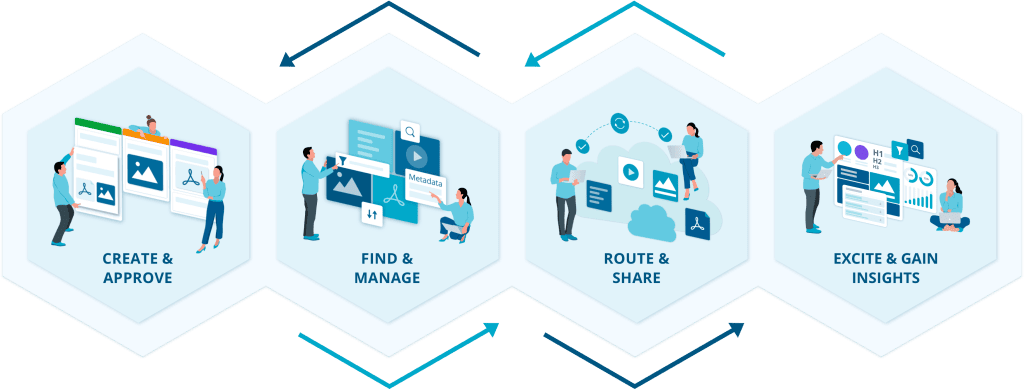
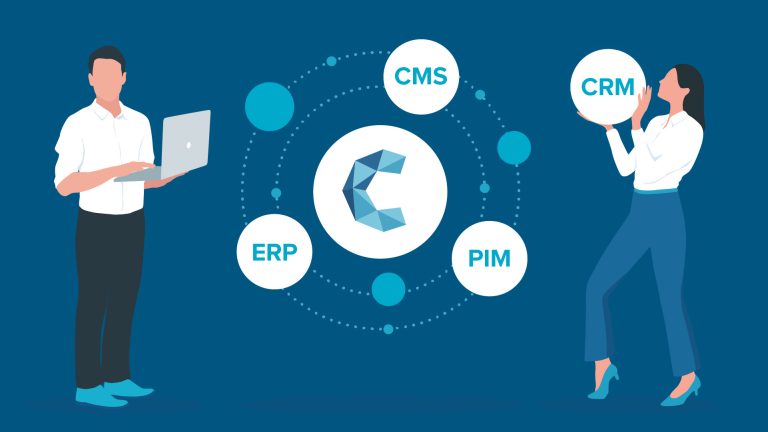
The common denominator: companies need a reliable, central foundation for product and brand content from which all channels can be served consistently. This is precisely what a Content Supply Chain platform provides as a System of Record.
To ensure that content reaches this system at the required level of quality, clear approval processes are also essential. Content Collaboration addresses this by ensuring that only reviewed and verified information reaches machine-readable channels.
And to ensure that this data reaches the places where agents actually retrieve it, professional Application Integrations enable the seamless flow of product information from the DAM into feeds, APIs and interfaces.
Our guide to creating an AI-ready website explains how to put these fundamentals into practice.
Practical Check: Is Your Content Optimised for AI Agents?
A quick self-assessment based on the five stages:
- Goal understanding: Do your product pages describe attributes precisely enough to match typical search criteria such as price, availability and technical specifications?
- Source access: Is your product data marked up in a structured format (Schema.org, JSON-LD) and accessible through open interfaces, or is it available only within visual website content?
- Evaluation & filtering: Are pricing, availability and product information consistent across all channels, or are there discrepancies between your website, feeds and marketplaces?
- Comparison & ranking: Are all your product attributes complete, or are important comparison fields missing?
- Decision & handover: Is there clear documentation for downstream human stakeholders showing which data formed the basis of the shortlist?
How Can Companies Protect Their AI Visibility?
An AI agent’s research is not a vague or unpredictable process. It follows a comprehensible structure with clear requirements at every stage.
Companies that understand what an agent is looking for at each point in the process can adapt their content accordingly, rather than simply hoping to be found.
Frequently Asked Questions About AI Agent Research
How Do You Use AI Agents?
You use AI agents by giving them a clear goal rather than instructing them on every individual step. The agent then independently handles the research, planning and execution of the necessary tasks. You generally only need to intervene to review the final result or confirm important decisions.
How Does an AI Agent Work?
An AI agent uses a language model as its central brain to analyse your objective and break it down into individual steps. It accesses external tools such as web browsers, databases or APIs to gather information and perform actions.
Through continuous feedback, it dynamically adjusts its approach until the task has been completed.
What Is the Structure of an AI Agent?
An AI agent essentially consists of a language model for decision-making, memory for maintaining context and tools for interacting with its environment. It also includes a planning module that structures complex goals and divides them into logical execution steps.
These components enable the agent to perceive its environment, reflect and take targeted action.
What Is the Difference Between an AI Agent and ChatGPT?
ChatGPT primarily responds directly to your prompts and generates text within a conversational chat interface. An AI agent, by contrast, operates largely autonomously, independently executes multi-step task sequences and actively uses external software tools.
ChatGPT can serve as the central logic component that powers such an agent.
Can an AI Agent Make Purchases or Bookings Independently?
Yes, AI agents can independently compare offers and complete booking forms through APIs or automated browser interactions.
However, for sensitive actions such as making an actual payment, security standards usually require your final approval. You therefore retain financial control.
What Is the Difference Between an AI Agent and a Bot?
Traditional bots rigidly follow predefined rules and if-then scripts. An AI agent, by contrast, uses artificial intelligence to understand unstructured data and respond flexibly to unexpected situations.
Within the scope of its assigned task, it can make its own decisions, making it significantly more adaptable than a simple bot.