Imagine your team reclaiming a third of its working time. That’s exactly what happens when you eliminate the “swivel-chair effect” – the constant manual switching between CMS platforms, social media tools and file servers.
The solution is not yet another isolated software tool, but intelligent connectivity. Strategic DAM integrations transform your Digital Asset Management platform from a static image repository into the dynamic, central engine of your Content Supply Chain.
Inhalt
The Benefits of DAM Integrations
The right integrations and interfaces for DAM platforms address the biggest challenges faced by modern CMOs and IT leaders, offering the following benefits:
- No system silos: Creative teams and marketers work directly within their preferred tools (such as Adobe Creative Cloud, Figma or their CMS). The download-upload cycle disappears entirely.
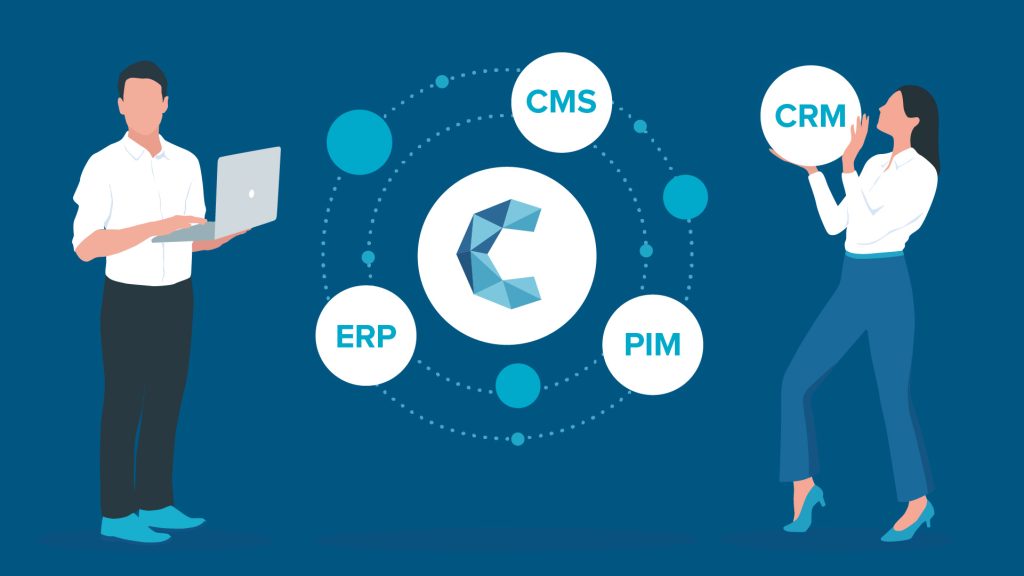
- A reliable Single Source of Truth: Because the DAM communicates seamlessly with CMS, PIM and ERP systems, every channel automatically uses the most up-to-date version of an asset.
- Faster time-to-market: Assets are automatically delivered in the correct format for each channel. This reduces manual effort and enables campaigns to go live in minutes instead of days.
6 Strategic Digital Asset Management Integrations
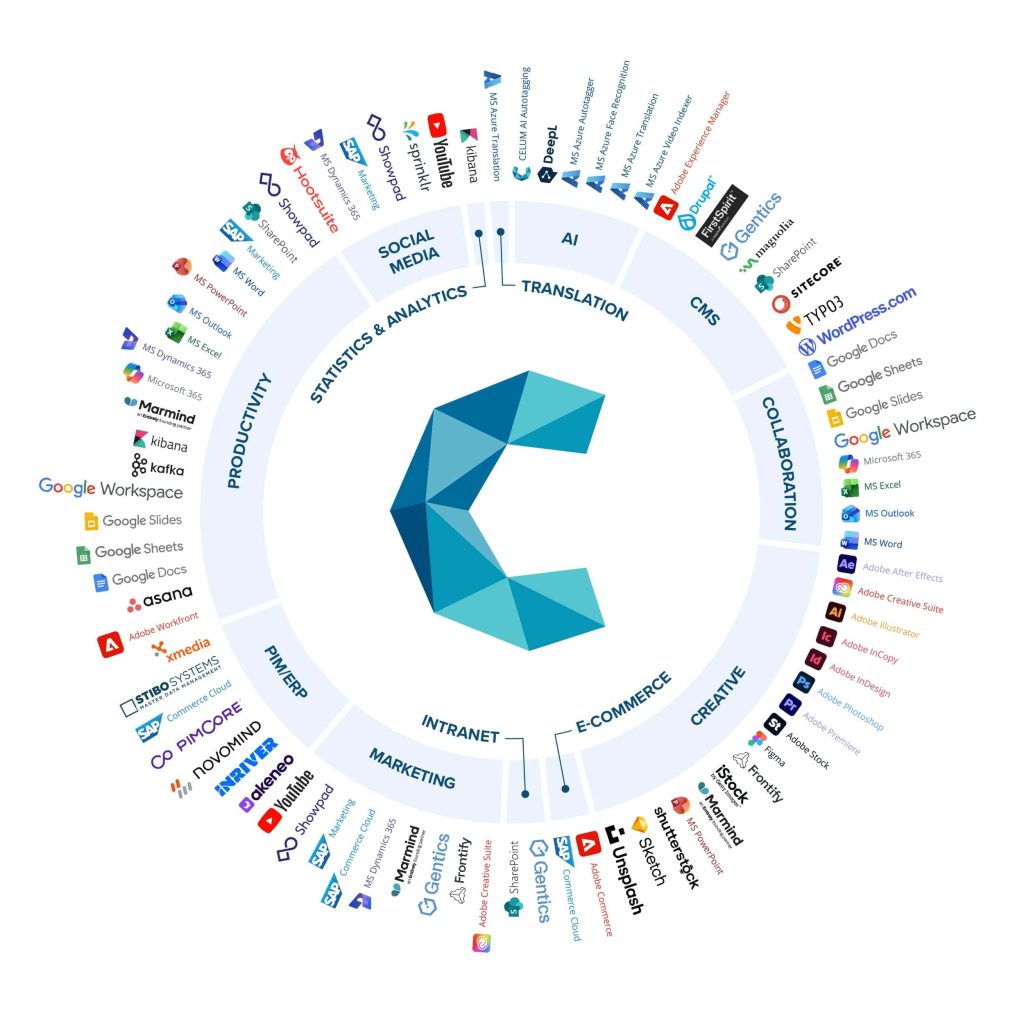
To automate the Content Supply Chain seamlessly, specific DAM integrations with an organisation’s leading systems must be established. These are the six most important integrations in practice:
1. Content Management Systems (CMS): Managing Web Content Without Media Breaks
Websites and corporate blogs thrive on compelling images and videos. Integrating DAM with a CMS dramatically simplifies editorial workflows.
How it works: Editors no longer need to leave the CMS to upload images. Instead, they access the central DAM library directly from the familiar CMS interface, select the required asset and insert it instantly.
Benefits: No more manual downloads and uploads. The DAM automatically delivers assets to the website in the correct format, at the right resolution and with maximum speed via a Content Delivery Network (CDN).
2. E-Commerce & Online Shops: Publishing Product Images at the Push of a Button
In online retail, milliseconds can determine whether a purchase is made. Customers expect high-resolution product imagery, close-ups and videos from multiple perspectives.
How it works: The DAM is connected to the e-commerce platform (e.g. Shopify, Magento or Shopware). As soon as a new product image is uploaded and approved in the DAM, it automatically appears in the shop frontend.
Benefits: No more error-prone media uploads in the shop backend. Automated optimisation for mobile and desktop devices ensures minimal loading times and an excellent user experience.
3. PIM & ERP: The Symbiosis of Product and Media Data
In both e-commerce and industrial B2B environments, product images, datasheets and videos are inseparable from structured product information.
How it works: Through intelligent DAM integrations, assets are automatically linked to corresponding product records in the PIM system (e.g. Akeneo or Contentserv) using unique identifiers such as SKUs or EAN numbers.
Benefits: When a product image changes in the DAM, it is automatically updated across online stores, printed catalogues and marketplaces. Incorrect asset assignments become a thing of the past.
4. CRM: On-Brand Content for Sales and Customer Service
Sales and account management teams rely on having immediate access to the right content for prospects and customers. A CRM integration (e.g. Microsoft Dynamics 365 or Salesforce) bridges the gap between marketing and sales.
How it works: Sales teams access approved sales collateral, presentation templates, case studies and product datasheets directly from the CRM interface and attach them to proposals or emails.
Benefits: Sales teams are guaranteed to use only the latest, brand-compliant materials. In addition, valuable insights flow back into the DAM, revealing which assets are most frequently and successfully used in customer interactions.
5. Creative Cloud & Enterprise Productivity: Where Content Is Created
Creative professionals work in their preferred environments, most commonly Adobe Creative Cloud applications such as Photoshop, InDesign and Premiere Pro, as well as Microsoft 365 applications such as Word, PowerPoint, Outlook and SharePoint.
Marketing, sales and product teams can work without switching between systems.
How it works: Native plugins and integrations allow users to access the DAM directly from Photoshop, InDesign, Microsoft 365 or SharePoint, check assets out, edit them and check the new versions back in.
Benefits: No time wasted searching through file systems, no local file storage and no risk of working on outdated asset versions.
6. Marketing Automation & Social Media: Distribution at the Push of a Button
Platforms such as HubSpot, Salesforce Marketing Cloud and Hootsuite require a constant flow of fresh, on-brand content for email campaigns and social media channels.
How it works: Approved campaign assets flow directly from the DAM into the media libraries of marketing automation platforms.
Benefits Omnichannel campaigns can be scaled rapidly because assets are already available in the correct format and enriched with the appropriate metadata.
The Next Step: Turn Your DAM into the Central Engine
Ready to eliminate the “swivel-chair effect” once and for all?
With CELUM’s Enterprise Digital Asset Management solution, you can build a highly scalable central platform for all your digital content.
Best of all, you do not need to reinvent the wheel. Through the CELUM Marketplace, you can access numerous DAM integrations and connect your existing tools using out-of-the-box connectors.
Best Practices for Implementing DAM Integrations
A successful DAM integration rarely fails because of vision; it usually fails because of architecture. To build a pragmatic and future-proof foundation, follow these best practices:
- API-first approach:
Choose a DAM that offers a modern and comprehensive REST or GraphQL API. This keeps your technology landscape flexible and supports a best-of-breed architecture if you want to replace components such as the CMS or PIM in the future. - Event-driven architecture (webhooks):
Replace scheduled synchronisation processes such as nightly batch updates with webhooks. As soon as an asset is approved within the DAM, the system triggers an event that updates connected channels in real time.
Use standardised connectors: CELUM already provides out-of-the-box connectors for the most common enterprise systems. Leveraging these standard integrations significantly reduces development effort, implementation risks and long-term maintenance costs.
Future Outlook: AI Agent Workflows Powered by DAM Integrations
The next evolution of DAM integrations is AI-powered and highly automated. Modern DAM platforms are no longer limited to internal AI capabilities such as auto-tagging. They increasingly act as intelligent content hubs that analyse, enrich and distribute content across channels.
For example, when a new product video enters the DAM, an AI agent can analyse the content, generate transcripts, translate them into five languages and automatically deliver the corresponding subtitles to an integrated video streaming component within the CMS.
At the same time, an integrated compliance AI can verify whether all visible brand logos comply with local market requirements before the asset is released to connected PIM, CRM and e-commerce systems.
Conclusion: Integration Is Not an IT Project, It's a Strategy
A Digital Asset Management platform only realises its full ROI potential when it stops operating as an isolated island. Seamless integration through strategically designed DAM connections eliminates data silos, reduces errors and measurably accelerates your Content Supply Chain.
Organisations that establish their DAM as the central nervous system of the MarTech stack create the infrastructure required for agile, scalable and consistent brand experiences across every touchpoint, from online stores to one-to-one customer interactions within the CRM.
Connect your systems so your teams can focus on what truly matters: creating exceptional content.